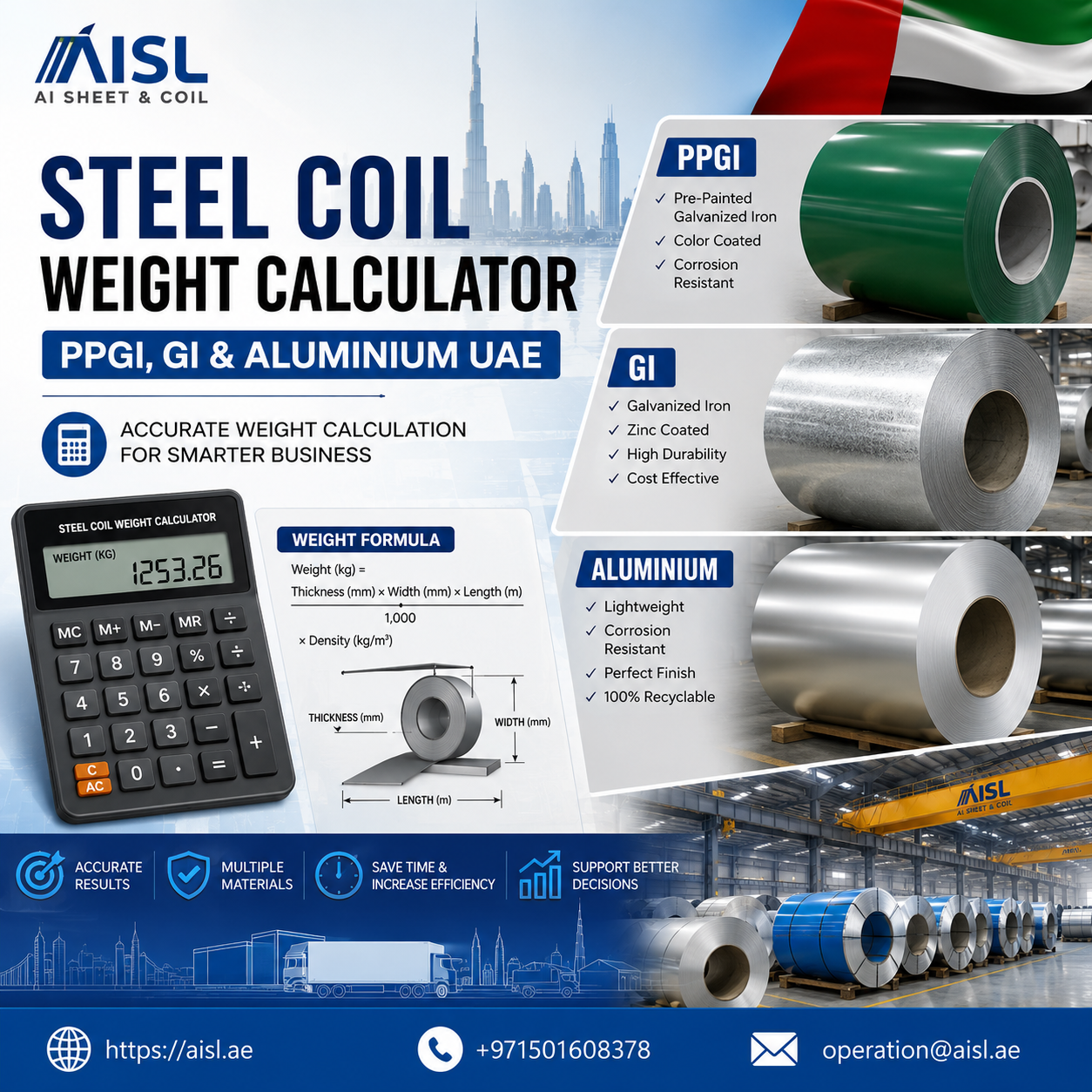
Steel Coil Weight Calculator — How to Calculate PPGI, GI and Aluminium Coil Weight Before You Order
If you are a procurement manager, fabricator, or contractor sourcing steel or aluminium coils in the UAE or GCC, calculating the correct coil weight before you place an order is not a minor administrative step — it directly affects your freight cost, warehouse planning, handling equipment requirements, and total order value. Ordering coils that arrive heavier or lighter than anticipated creates downstream problems across your entire production schedule. Yet a clear, reliable method for calculating coil weight for PPGI, galvanized steel, Aluzinc, and prepainted aluminium coils is rarely provided by suppliers in a format that procurement and operations teams can use immediately on the floor.
In this guide, we explain the correct formula for calculating steel and aluminium coil weight, provide the density values for each major coil type, walk through three worked examples using AISL's standard specifications, and highlight the most common calculation errors that lead to costly ordering mistakes.
The Core Formula: How Coil Weight Is Calculated
The weight of a metal coil is determined by four variables: the thickness of the strip, the width of the strip, the total length of the strip wound onto the coil, and the density of the metal. These four values, multiplied together, give you the coil weight in kilograms.
The formula is:
Weight (kg) = Thickness (m) × Width (m) × Length (m) × Density (kg/m³)
All dimensions must be converted to metres before the calculation. Thickness is typically specified in millimetres (divide by 1,000), and width is usually given in millimetres as well (divide by 1,000). Length is given in metres and can be used directly. Density varies by material and is expressed in kilograms per cubic metre.
The single most common error procurement teams make is failing to convert units consistently before applying the formula — particularly confusing millimetres and metres for the thickness value, which produces a result 1,000 times incorrect. The second most common error is applying the density of plain carbon steel to all coil types, including aluminium — which has a density approximately one-third that of steel and produces a dramatically overstated weight estimate if the wrong density is used.
Density Reference Table — PPGI, GI, Aluzinc, PPAZ and Aluminium
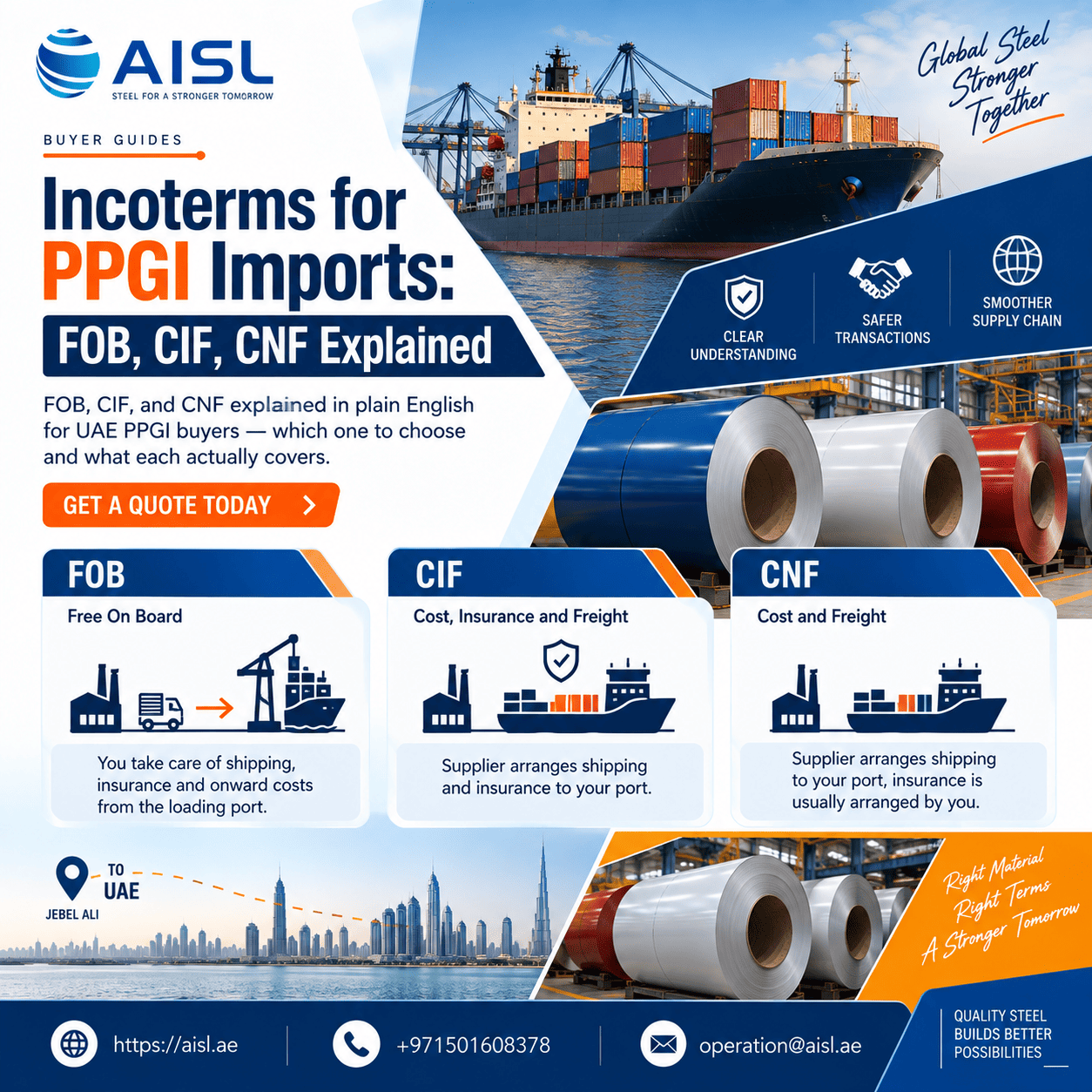
The density value applied in the formula must match the specific material being ordered. The following density values are used in standard coil weight calculations across the industry:
| Material | Density (kg/m³) |
|---|---|
| Hot-Dip Galvanized Steel (GI) | 7,850 |
| Prepainted Galvanized Steel (PPGI) | 7,850 |
| Aluzinc / Galvalume Steel (AZ) | 7,700 |
| Prepainted Aluzinc (PPAZ) | 7,700 |
| Aluminium Alloy (1100, 3003, 3105) | 2,710 |
| Prepainted Aluminium (PPAL) | 2,710 |
The slightly lower density of Aluzinc compared to plain galvanized steel reflects the aluminium-zinc alloy coating composition (55% aluminium, 43.4% zinc), which has a lower mass per unit volume than a pure zinc coating. For Prepainted Aluminium (PPAL) coils, the density difference relative to steel is substantial — a PPAL coil of identical dimensions will weigh approximately 65% less than an equivalent PPGI coil, which has major implications for structural loading calculations, crane capacity, and logistics planning.
Three Worked Examples Using AISL Standard Specifications
Example 1 — PPGI Coil: Standard Roofing Specification
A roofing contractor in Dubai orders a PPGI coil with the following specification: 0.50 mm thickness, 1,220 mm width, 2,500 m length.
- Thickness: 0.50 mm ÷ 1,000 = 0.0005 m
- Width: 1,220 mm ÷ 1,000 = 1.220 m
- Length: 2,500 m
- Density: 7,850 kg/m³
Weight = 0.0005 × 1.220 × 2,500 × 7,850 = 11,982 kg ≈ 11.98 MT
This coil falls within the upper range of AISL's standard output coil weight of 2.00 to 5.00 MT per coil, meaning the 2,500 m length would be split across multiple coils at the mill — typically three coils of approximately 4.00 MT each from a single input slab. When ordering, always confirm whether the length quoted is per coil or per order lot.
Example 2 — GI Coil: Industrial Application
A fabricator in Sharjah orders a Galvanized Steel coil for a structural panel application: 0.80 mm thickness, 1,000 mm width, 1,800 m length.
- Thickness: 0.80 mm ÷ 1,000 = 0.0008 m
- Width: 1,000 mm ÷ 1,000 = 1.000 m
- Length: 1,800 m
- Density: 7,850 kg/m³
Weight = 0.0008 × 1.000 × 1,800 × 7,850 = 11,304 kg ≈ 11.30 MT
Again, this would be delivered as multiple coils. AISL's standard output coil weight for steel products is 2.00 to 5.00 MT — confirm the number of coils and individual coil weights with your supplier when placing the order, particularly if your uncoiling or slitting equipment has a maximum coil weight capacity.
Example 3 — PPAL Aluminium Coil: Ceiling and HVAC Application
A ceiling contractor in Abu Dhabi orders a Prepainted Aluminium (PPAL) coil for a false ceiling installation: 0.70 mm thickness, 1,000 mm width, 2,000 m length.
- Thickness: 0.70 mm ÷ 1,000 = 0.0007 m
- Width: 1,000 mm ÷ 1,000 = 1.000 m
- Length: 2,000 m
- Density: 2,710 kg/m³
Weight = 0.0007 × 1.000 × 2,000 × 2,710 = 3,794 kg ≈ 3.79 MT
This confirms AISL's standard output coil weight range for aluminium of 1.00 to 3.00 MT per coil — meaning this order would be delivered as two coils. The dramatically lower coil weight compared to an equivalent steel specification is a key logistics advantage for ceiling and façade contractors, where manual handling and crane access at height are operational constraints.
Calculating Length From a Known Coil Weight
A reverse calculation is equally useful when you know your target coil weight and need to determine how many metres of strip that represents — common when planning a production run against a fixed material budget.
Length (m) = Weight (kg) ÷ (Thickness (m) × Width (m) × Density (kg/m³))
For a 4.00 MT PPGI coil at 0.50 mm thickness and 1,220 mm width:
Length = 4,000 ÷ (0.0005 × 1.220 × 7,850) = 4,000 ÷ 4.789 = 835 m per coil
This reverse calculation is particularly useful for slitting line operators in UAE processing facilities, where production scheduling requires accurate strip length estimates per coil before uncoiling begins. AISL's Steel Coil Processing Facility offers IGBT-powered high-precision slitting and cut-to-length services for buyers who need coils processed to custom widths or sheet lengths before delivery.
Common Mistakes to Avoid When Ordering Coils by Weight
Three calculation and ordering errors recur consistently across the UAE procurement market. The first — unit conversion errors — has already been addressed: always convert thickness and width to metres before applying the formula.
The second error is ordering by weight without confirming the output coil OD (outer diameter) and ID (inner diameter). A 5.00 MT PPGI coil at 0.50 mm thickness will have a significantly larger outer diameter than a 5.00 MT coil at 1.00 mm thickness, and if your uncoiling mandrel or reel has a fixed ID capacity (typically 508 mm in the UAE market, matching AISL's standard output coil ID), a mismatch causes handling delays on the production floor.
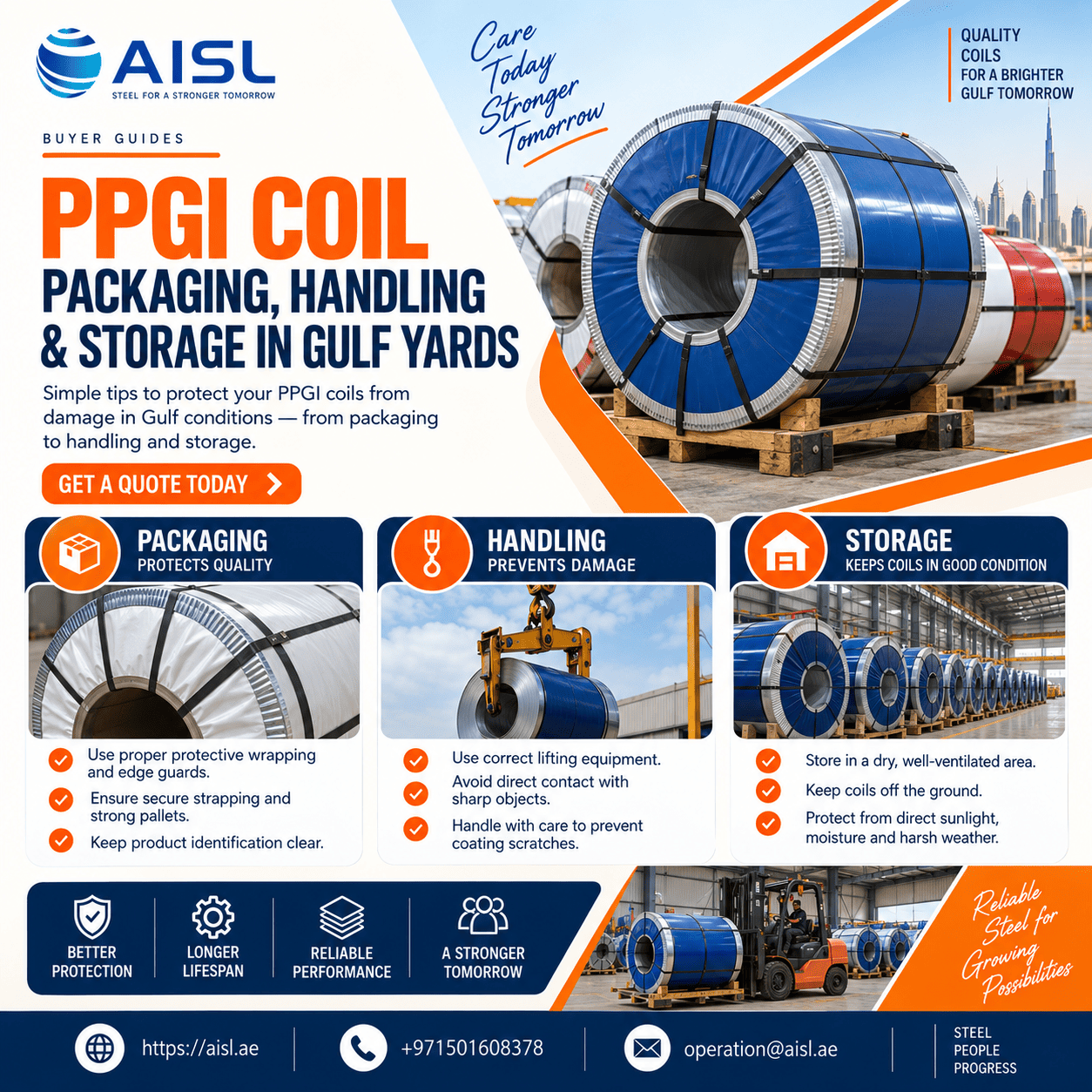
The third error is failing to account for coating weight when specifying galvanized or prepainted products. A zinc coating of 275 GSM on a GI coil adds approximately 0.55 kg per square metre of strip — a figure that becomes significant at high order volumes and affects both the total coil weight calculation and the material cost per tonne.
AISL: Coil Specifications, Processing, and Technical Support in UAE
Arabian Iron and Steel LLC manufactures PPGI, PPAZ, PPAL, Galvanized Steel, and Aluzinc Steel coils at its Continuous Colour Coating Line facility in Umm Al Quwain, UAE, with output coil weights of 2.00 to 5.00 MT for steel products and 1.00 to 3.00 MT for aluminium products, and coil widths from 650 mm to 1,350 mm across all product types. Every coil is manufactured under ISO 9001, ISO 14001, and ISO 45001 certified quality management systems, with SASO certification for orders shipping to the Kingdom of Saudi Arabia.
AISL's technical team is available to assist procurement managers, fabricators, and contractors across the UAE, Saudi Arabia, Oman, and Qatar with coil weight calculations, specification selection, and custom order planning. To request a product datasheet, coil specification sheet, or project quotation, contact the team at aisl.ae/contact-us or submit your enquiry at aisl.ae#enquire.