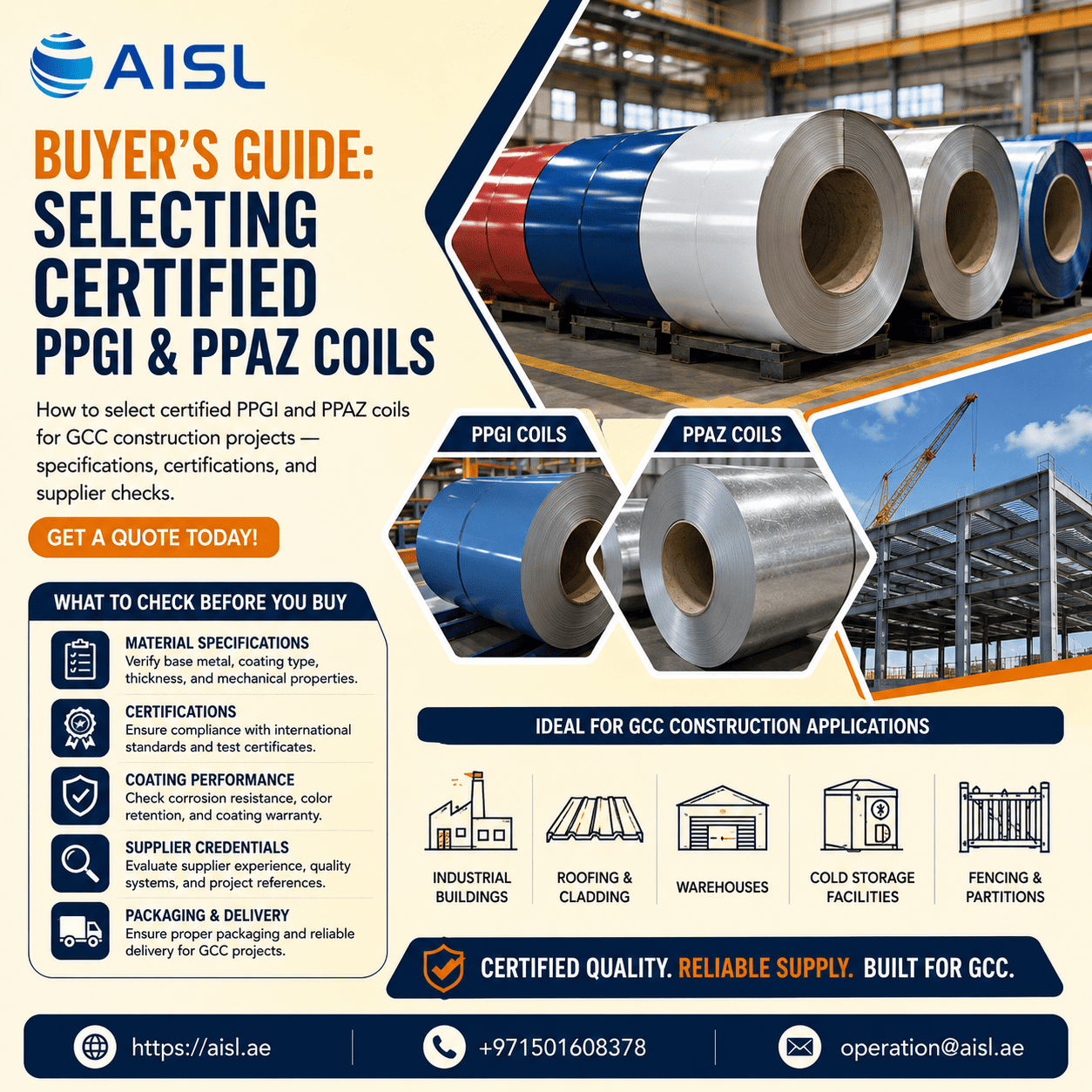
This guide walks contractors, fabricators, and procurement teams through the key factors to evaluate before confirming a coil order for a GCC project.
Buyer's Guide: How to Select Certified PPGI and PPAZ Coils for GCC Construction Projects
Selecting coated steel coil for a GCC construction project involves more decisions than most buyers expect. Beyond simply choosing "PPGI" or "PPAZ" as a category, the actual performance of the material depends on a stack of specifications — coating class, paint system, certification, and supplier documentation — that vary considerably between suppliers quoting for what looks like the same product on paper.
Start With the Right Base Material: PPGI or PPAZ
PPGI (Prepainted Galvanized Steel) uses a zinc-coated steel substrate with a factory-applied paint finish, and remains the standard choice for general roofing, cladding, and structural applications across inland GCC construction, offering strong cost efficiency alongside solid corrosion protection.
PPAZ (Prepainted Aluzinc) replaces the pure zinc coating with an aluminum-zinc alloy, offering stronger corrosion resistance in coastal, high-humidity, or industrial-pollution environments common across Gulf port cities and coastal construction zones. For projects near the coastline in the UAE, Saudi Arabia, Qatar, or Oman, PPAZ is generally the more defensible long-term specification despite its higher cost per tonne.
Specification Checklist Before You Buy
1. Zinc or Aluzinc Coating Class
Coating weight, expressed as GSM or a Z rating (Z80, Z180, Z275, and higher), is the single biggest factor in how long the coil resists corrosion. Match the coating class to your project's actual exposure — coastal sites generally warrant Z275 or higher, while inland structures with limited weather exposure may be adequately served by Z180.
2. Paint Coating System
Regular Modified Polyester (RMP) covers most standard roofing and cladding needs cost-effectively. Silicon Modified Polyester (SMP) offers a step up in UV and weathering resistance for standard exterior applications. PVDF is the premium option, built for 20+ years of colour and gloss retention on long-design-life or highly visible facade projects.
3. Coil Thickness and Width
Confirm thickness (typically 0.20mm to 1.50mm for PPGI and PPAZ) and width (650mm to 1350mm) match your roll-forming line or fabrication requirements before placing an order — mismatched dimensions create unnecessary trim waste and processing delays.
4. Coating Thickness in Microns
Standard specification is typically 5 microns primer plus 20 microns top coat, with customised coatings available up to 200 microns for specialised applications such as cold storage or food-grade panels. Confirm the coating thickness matches your project specification, not a generic default.
Certification: What to Actually Verify
Manufacturer Quality Certifications
Look for suppliers holding ISO 9001 (quality management), ISO 14001 (environmental management), and ISO 45001 (occupational health and safety) certification. These indicate documented, auditable production processes rather than one-off quality claims, and are increasingly requested by main contractors and consultants on GCC construction tenders.
Regional Compliance Certification
For projects in Saudi Arabia and other GCC markets, confirm SASO compliance where applicable — this is often a prerequisite for material approval on government and large-scale commercial projects.
Mill Test Certificates
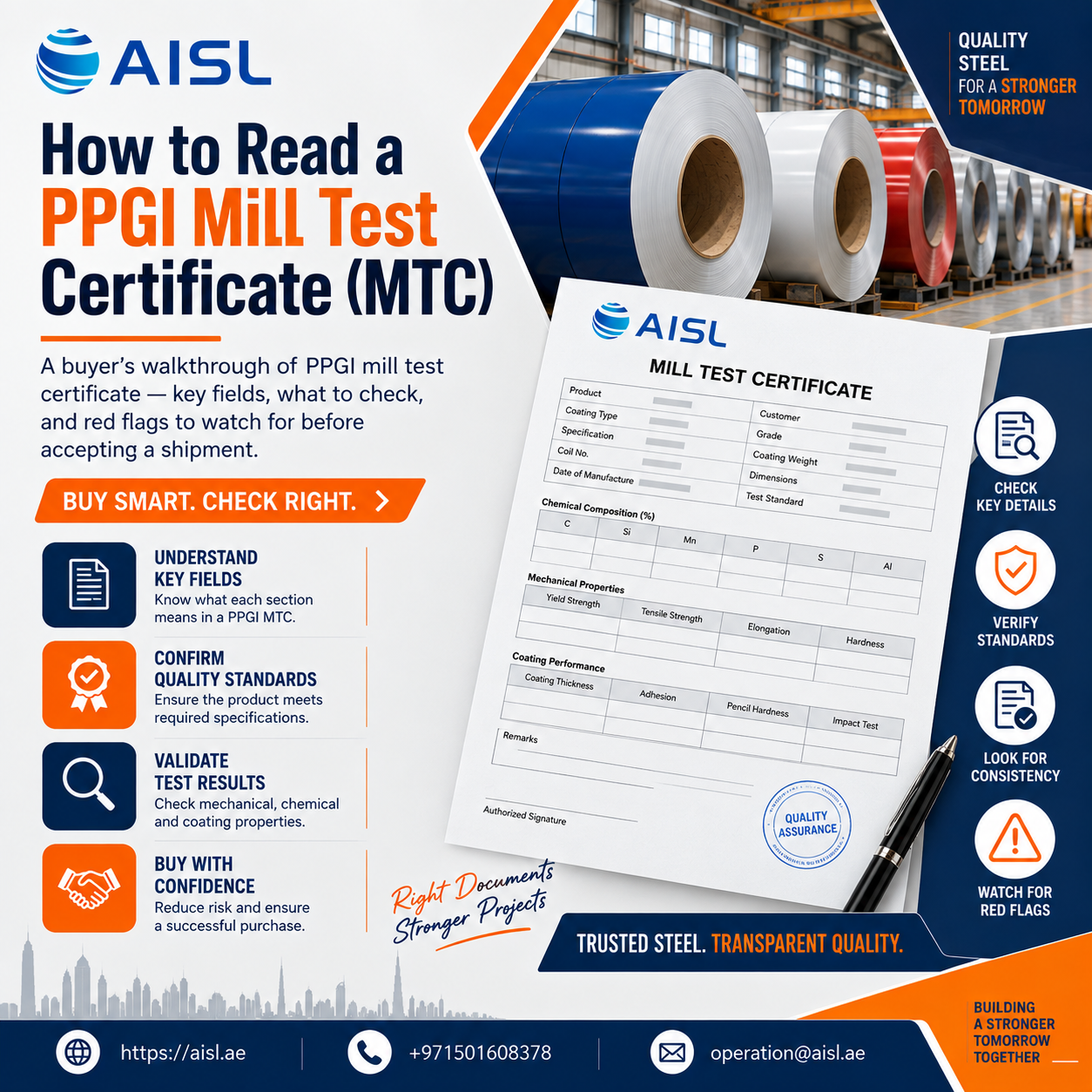
Every batch of coil should come with a mill test certificate confirming the actual tested coating weight, base metal grade, and paint specification for that specific production run — not a generic figure copied from a product datasheet. This is the document your quality team should request and retain for every shipment, particularly on projects requiring warranty documentation.
Verifying Before You Commit to Bulk Volume
Request a sample coil before confirming a large order, so your team can test paint adhesion and coating uniformity directly rather than relying on datasheet claims alone.
Weigh a sample coil against its stated dimensions — a gap of more than two to three percent between stated and actual weight is a warning sign worth raising with the supplier before the full order ships.
Ask for traceable batch documentation covering the full production chain, particularly important for projects where warranty claims may surface years after installation.
Common Mistakes to Avoid
Choosing a supplier on price alone without verifying certification is the most frequent way buyers end up with coil that underperforms its stated specification. Equally common is assuming all "PPGI" or "PPAZ" coil is interchangeable regardless of coating class or paint system — two coils with the same product name can perform very differently depending on the specifications behind them.
Certified PPGI and PPAZ Coil from AISL
Arabian Iron and Steel LLC (AISL) manufactures PPGI, PPAZ, and PPAL coils at our Continuous Color Coating Line in Umm Al Quwain, UAE, under ISO 9001, ISO 14001, ISO 45001, and SASO certification. Every batch is fully traceable, with mill test certificates and coating specifications available on request, so you know exactly what you're building with before it reaches site.
If you're sourcing certified PPGI or PPAZ coil for a GCC construction project, contact our team for a specification-matched quote.