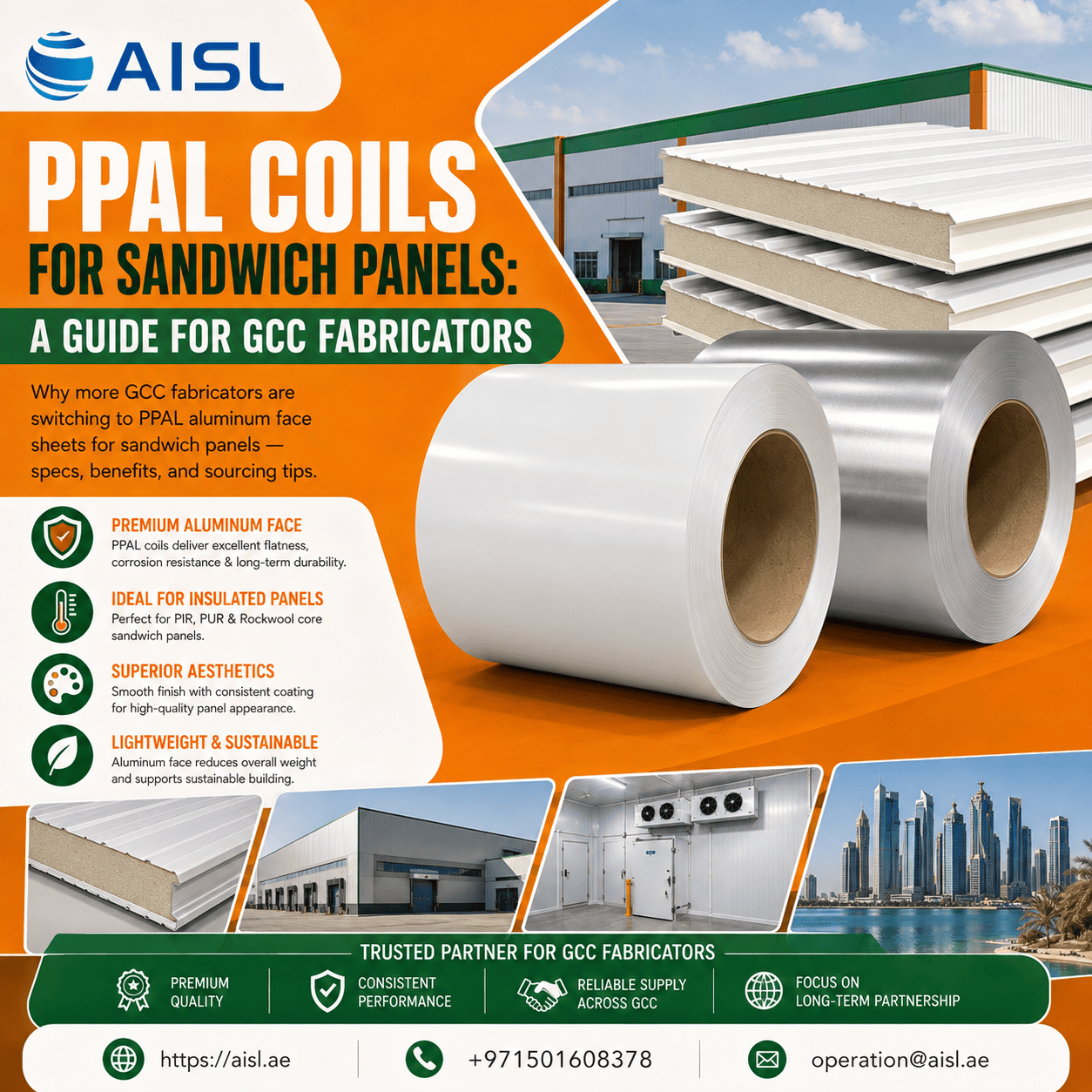
PPAL Coils for Sandwich Panels: Why More GCC Fabricators Are Switching to Aluminum Face Sheets
Sandwich panel manufacturers across the UAE, Saudi Arabia, Qatar, and Oman have traditionally defaulted to steel-based facings — PPGI or PPAZ — for the vast majority of panel production. But a growing share of fabricators are now specifying Prepainted Aluminum (PPAL) coil for the outer facing sheet, particularly on projects where weight, corrosion resistance, or facade appearance carry more weight than raw material cost alone.
This guide explains what PPAL is, how it compares to PPGI as a panel facing material, and when it is the better specification for a GCC fabrication project.
What Is PPAL Coil?
Prepainted Aluminum (PPAL) coil is produced by applying a coating system directly onto an aluminum alloy substrate — commonly grades such as 3003, 3105, or 5052 — rather than onto a zinc-coated steel base. Because aluminum forms its own stable oxide layer naturally, PPAL does not rely on a sacrificial zinc coating for corrosion protection the way PPGI or PPAZ does, which changes both its performance profile and its handling characteristics on a production line.
PPAL vs PPGI: The Practical Differences for Panel Manufacturers
Weight
Aluminum is significantly lighter than steel for the same sheet thickness, which reduces the overall weight of a finished sandwich panel. This matters directly for large-span roofing systems, structures with lighter-gauge framing, and any project where reducing dead load simplifies the structural design or lowers transport and handling costs.
Corrosion Resistance
While PPGI and PPAZ rely on zinc or Aluzinc coatings that sacrificially corrode to protect the base steel, aluminum's natural oxide layer provides inherent corrosion resistance without depending on a coating breach point. This makes PPAL a strong option for coastal facilities, marine-adjacent sites, and high-humidity environments common along the UAE and Omani coastlines, where salt exposure accelerates steel corrosion but has comparatively less effect on aluminum.
Formability and Finish
Aluminum's formability allows for tighter bends and more complex profile shapes without cracking the paint film, which is one reason PPAL is often specified for architectural facades, curved cladding, and decorative panel applications where PPGI's stiffness can limit design flexibility.
Cost
PPAL generally carries a higher material cost per tonne than PPGI, reflecting both the base metal price and the specialised coating process. Fabricators typically weigh this against the weight, corrosion, and design benefits — PPAL tends to be specified where those advantages justify the premium, rather than as a blanket replacement for PPGI across all panel production.
Where PPAL Makes the Strongest Case
Coastal and marine-adjacent facilities — logistics hubs, ports, and industrial zones along the Gulf coastline benefit from aluminum's inherent corrosion resistance without needing to over-specify zinc coating class to compensate for salt exposure.
Architectural facades and visible cladding — projects where finish quality, colour consistency, and design flexibility matter more than raw material cost, such as commercial buildings, showrooms, and branded retail facades.
Weight-sensitive structural applications — large-span roofing or wall systems where reducing panel weight simplifies structural framing requirements or transport logistics for remote project sites.
For general warehousing, industrial sheds, and cost-driven roofing projects without significant coastal exposure, PPGI generally remains the more cost-efficient specification.
What to Check Before Specifying PPAL for a Panel Project
Alloy grade suited to the application. Structural or higher-stress applications require different aluminum alloy grades than purely decorative facades — confirm the alloy matches your engineering requirements, not just the coating finish.
Coating system compatibility. Confirm the paint system (RMP, SMP, PVDF) is validated for adhesion on aluminum substrate specifically, since coating performance on aluminum differs from coating performance on galvanized steel.
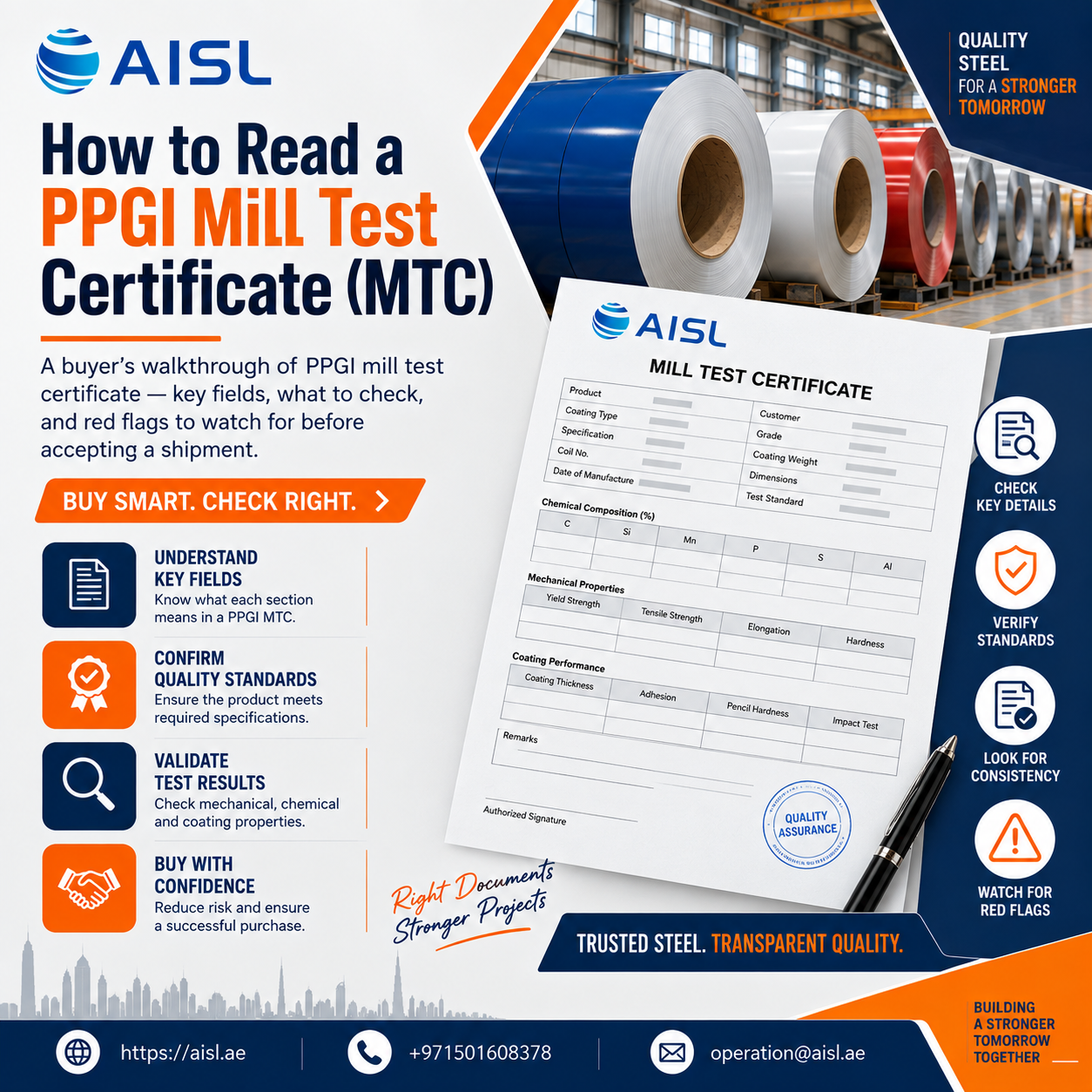
Mill test certification. Request documentation confirming alloy grade, temper, and coating specification for the batch supplied, the same way you would for PPGI or PPAZ coil.
Consistent supply across production runs. Colour and finish consistency between coil batches matters as much for PPAL as for any other facing material, particularly on large architectural facade projects where mismatched panels are highly visible.
PPAL Coil Supply from AISL
Arabian Iron and Steel LLC (AISL) manufactures PPAL, PPGI, and PPAZ coils at our Continuous Color Coating Line in Umm Al Quwain, UAE, with alloy and coating options suited to sandwich panel, façade, and architectural cladding applications across the UAE, GCC, and export markets. Every batch is fully traceable, with mill test certificates available on request.
If you are evaluating PPAL for an upcoming sandwich panel or facade project, contact our team for a specification-matched quote.