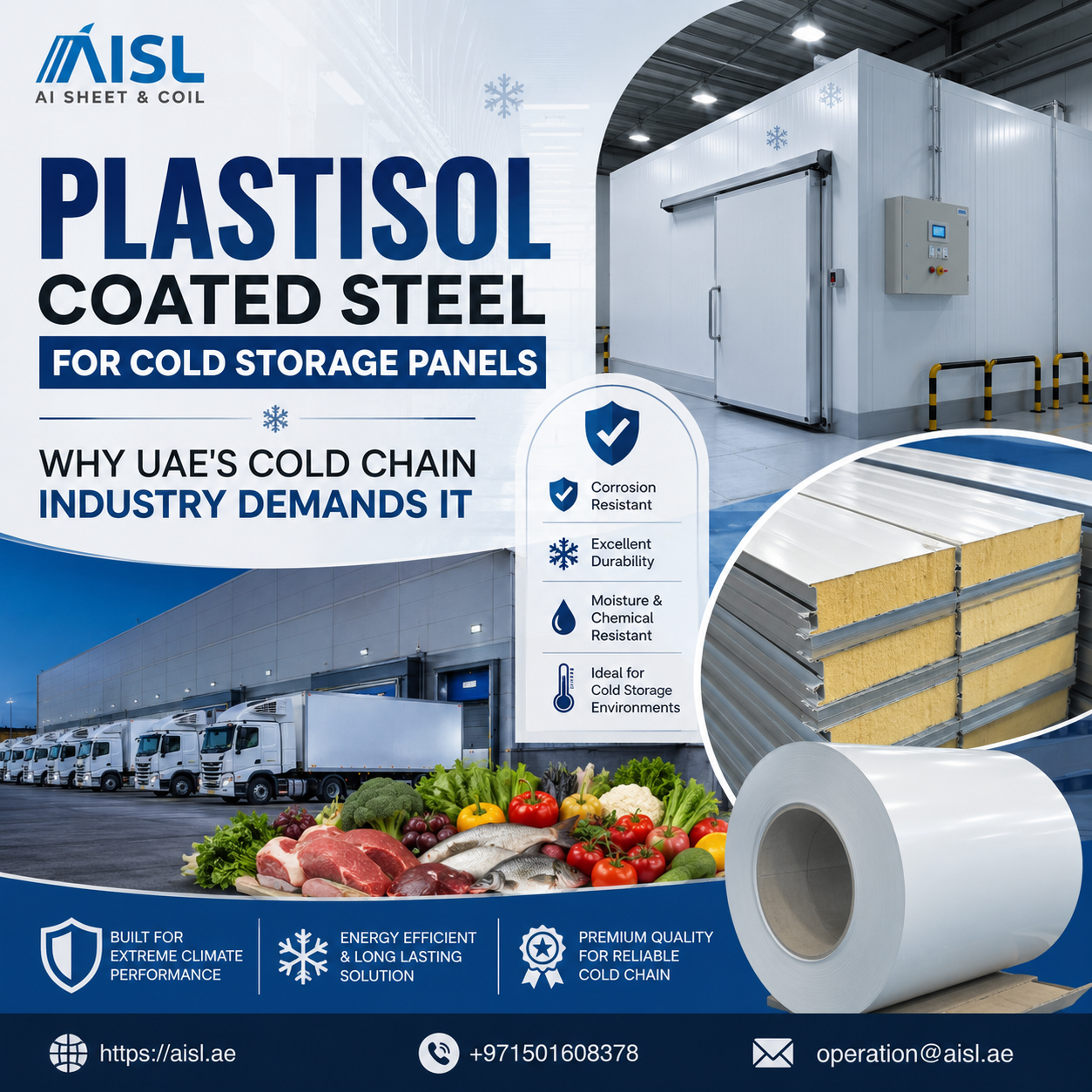
If you are building, fitting out, or procuring panels for a cold storage facility, food processing plant, or pharmaceutical warehouse in the UAE or GCC, the choice of coated steel substrate deserves more attention than it typically receives. Standard polyester-coated steel — the default specification in most general construction applications — performs poorly in cold storage environments, where condensation cycles, mechanical impact, and chemical cleaning agents combine to degrade surface coatings far faster than the original specification would suggest. The result is panels that corrode, peel, and fail years before their expected service life.
In this guide, we explain what Plastisol coating is, why it outperforms every alternative in cold storage and food processing environments, and how to specify the right product for your facility in the UAE.
The UAE Cold Storage Sector Is Expanding — and Panel Specification Matters More Than Ever
The UAE's cold chain logistics industry is growing at a compound annual growth rate of 7.56% through 2034, driven by rising demand for fresh food, pharmaceutical storage, and vaccine distribution infrastructure across Dubai, Abu Dhabi, Sharjah, and the wider GCC. New cold storage facilities are being commissioned across industrial zones in Umm Al Quwain, Jebel Ali, and Khalifa Industrial Zone — and the quality of the panel material used in their construction determines both the service life of the facility and its long-term compliance with food safety and hygiene regulations.
Cold room panels are not a passive component. They are exposed to a demanding and highly specific set of stressors: extreme temperature differentials between the ambient UAE exterior — which regularly exceeds 45°C in summer — and the controlled interior environment, which can reach as low as -25°C in frozen storage applications. This thermal cycling causes repeated expansion and contraction of panel materials, which stresses coating adhesion at the substrate interface. Add condensation moisture, forklift impact on panel surfaces, and the frequent application of industrial cleaning chemicals, and the performance requirements of the coating system become clear. Standard polyester coatings — typically applied at 20–25 microns — are not engineered for this combination of stressors.
What Is Plastisol Coating?
Plastisol is a PVC-based coating system in which fine-particle polyvinyl chloride (PVC) resins are dispersed in a liquid plasticiser medium. Unlike solvent-based paint systems that dry through evaporation, Plastisol remains liquid at room temperature and fuses into a continuous, homogeneous film only when heated in the curing oven — a process that produces a coating of exceptional toughness, flexibility, and adhesion strength.
The critical distinction between Plastisol and conventional coil coatings lies in film thickness. Standard polyester or SMP coatings are applied at 20 to 25 microns. Plastisol is applied at thicknesses of up to 200 microns — eight to ten times the film build of a standard system. This increased thickness is not merely cosmetic; it is what gives Plastisol its resistance to impact, abrasion, and moisture penetration that makes it the specified standard in cold chain construction globally.
Why Standard Polyester Coating Fails in Cold Storage Environments
Condensation and Moisture Cycling
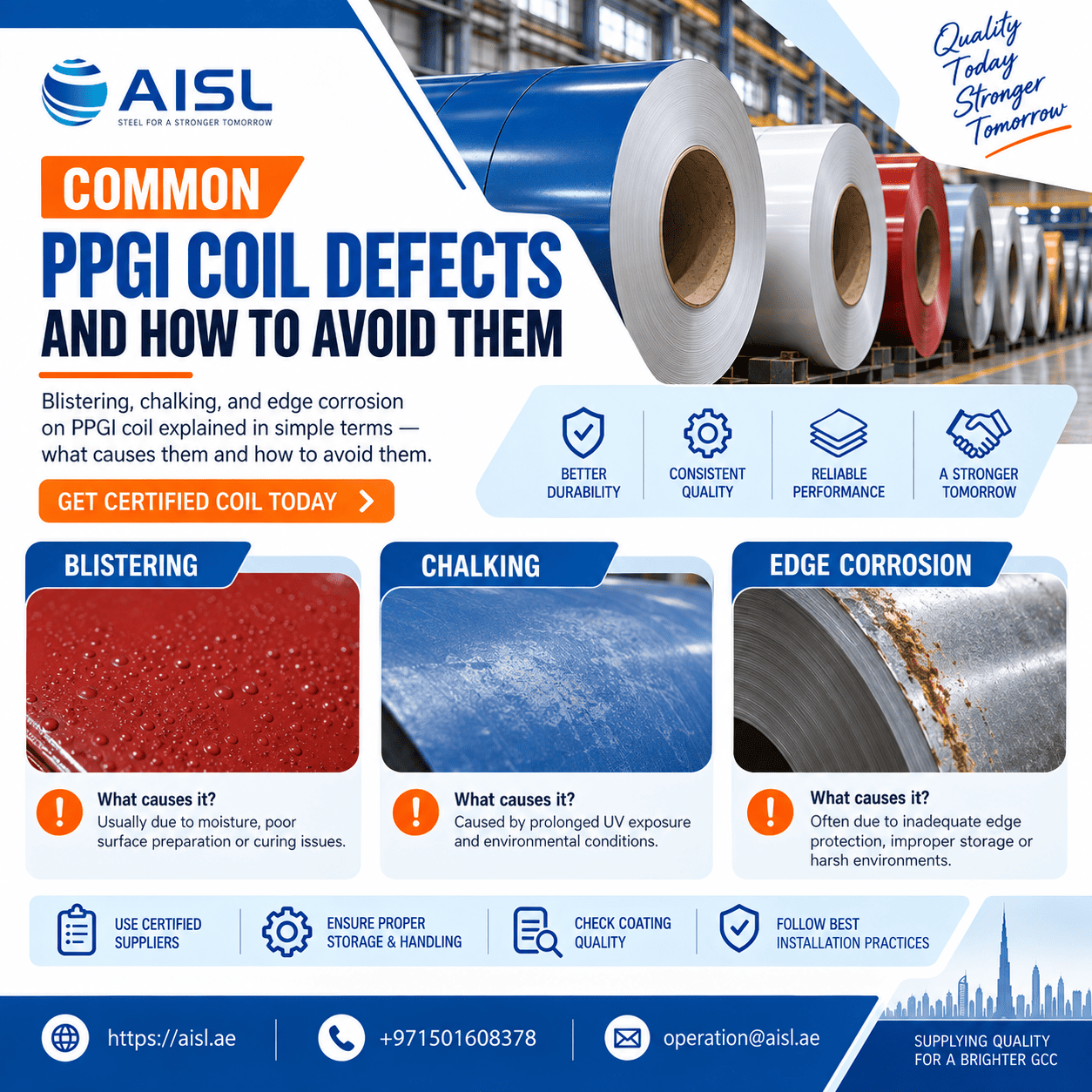
In a cold storage facility, the exterior face of a panel is exposed to UAE ambient humidity and heat, while the interior face is maintained at sub-zero or near-zero temperatures. This creates a persistent condensation zone within and around the panel structure. Over time, moisture penetrating micro-defects in a thin polyester coating reaches the substrate, initiating corrosion that spreads beneath the paint film and causes delamination — visible as blistering or lifting of the coating from the steel surface. A 200-micron Plastisol film presents a vastly superior barrier to moisture ingress, maintaining surface integrity across thousands of thermal cycles throughout the facility's operational life.
Mechanical Impact Resistance
Cold storage facilities are working environments. Forklift trucks, pallet jacks, loading equipment, and heavy goods contact with panel surfaces is unavoidable during normal operations. Standard polyester coatings chip and crack on impact, exposing the galvanized substrate to the corrosive cold room environment. Plastisol coatings, with their high-build PVC film, absorb and dissipate impact energy without cracking or delamination — a performance characteristic classified under ASTM D3359 impact testing, which Plastisol passes at 60 inch-lbs (8J) with no paint removal.
Chemical Cleaning Resistance
Food processing and pharmaceutical cold storage environments require regular, rigorous cleaning with industrial disinfectants, acid washes, and alkaline detergents. These cleaning agents attack thin organic coatings, causing accelerated gloss loss, softening, and eventual coating failure. The dense PVC matrix of a Plastisol coating resists a broad spectrum of chemicals, maintaining surface integrity through repeated cleaning cycles in compliance with food grade hygiene standards.
Plastisol Coating Specifications — What to Look For
When specifying Plastisol coated steel for cold storage panel production in the UAE, the key parameters to confirm with your supplier are coating thickness, substrate type, finish, and coil dimensions.
Coating thickness should be a minimum of 150 microns for standard cold room applications and up to 200 microns for frozen storage or food processing environments where cleaning chemical exposure is frequent. The substrate of choice for cold storage is either hot-dip galvanized steel with a zinc coating weight of 275 GSM or above, or Aluzinc steel — which offers superior corrosion resistance at the cut edges and panel joints that are most vulnerable in a cold room environment. Surface finish is available in smooth or leather-grain texture; leather-grain is increasingly preferred in food processing applications as it conceals minor surface marks between cleaning cycles and presents a hygienic, professional interior appearance.
Applications Across the Cold Chain — Where Plastisol Steel Is Specified
Cold Storage and Freezer Rooms
Plastisol coated steel on a galvanized or Aluzinc substrate is the standard panel facing material for cold rooms operating from +5°C (chilled storage) down to -25°C (deep frozen storage) in distribution centres, food retail back-of-house facilities, and logistics hubs across Dubai, Sharjah, and Abu Dhabi. Its combination of thermal cycling resistance, impact toughness, and moisture barrier performance makes it the specification of choice for panel manufacturers supplying these sectors.
Food Processing Facilities
In meat processing, dairy production, and seafood handling facilities — sectors with significant and growing presence in UAE free zones and industrial areas — wall and ceiling panels face daily exposure to water, steam, blood, brine, and cleaning chemicals. Plastisol coated steel, particularly in the smooth-finish variant, meets the hygiene surface requirements of these environments and complies with food-grade material standards applicable to direct food-contact wall surfaces.
Pharmaceutical and Vaccine Storage
Cold chain pharmaceutical storage requires panel materials that maintain dimensional and surface integrity across tightly controlled temperature ranges and that resist the cleaning protocols — including isopropyl alcohol and quaternary ammonium compounds — used in GMP-compliant environments. Plastisol on an Aluzinc substrate is the correct material specification for these applications, providing the surface durability and chemical resistance that regulatory compliance demands.
Industrial Refrigeration and Fish Processing
In fishing industry applications — particularly relevant to GCC coastal operations in Oman, Saudi Arabia, and the UAE — Plastisol coated steel on an Aluzinc substrate combines salt spray resistance with impact toughness for panel systems operating in the most demanding cold and humid environments. AISL's Stucco Embossed Aluminium Coils are also specified in combination with Plastisol facings for insulation jacket applications in these environments.
AISL: Your Plastisol Coated Steel Supplier for Cold Storage in the UAE
Arabian Iron and Steel LLC manufactures Plastisol coated steel coils at its Continuous Colour Coating Line (CCL) facility in Umm Al Quwain, UAE, with the capability to apply Plastisol in smooth and leather-grain finishes at thicknesses up to 200 microns on both galvanized steel and Aluzinc substrates. With an annual production capacity of 150,000 MT and coil widths from 650 mm to 1,350 mm, AISL supplies cold room panel manufacturers, sandwich panel producers, and industrial contractors across the UAE, Saudi Arabia, Oman, Qatar, and export markets in Africa.
Every coil is manufactured under ISO 9001, ISO 14001, and ISO 45001 certified quality management systems, with SASO certification for projects in the Kingdom of Saudi Arabia. AISL's technical team can advise on the correct substrate, Plastisol thickness, finish, and coil specification for your specific cold storage application — whether that is a 500 m² chilled retail back-of-house in Dubai or a 10,000 m² frozen distribution centre in Riyadh.
To request a Plastisol product sample, technical datasheet, or project quotation, contact the AISL team at aisl.ae/contact-us or submit your enquiry directly at aisl.ae#enquire.