This guide walks through what an MTC actually contains and what to verify before signing off on a shipment.
How to Read a PPGI Mill Test Certificate (MTC): A Buyer's Walkthrough
This guide walks through what an MTC actually contains and what to verify before signing off on a shipment.
What an MTC Is (and Isn't)
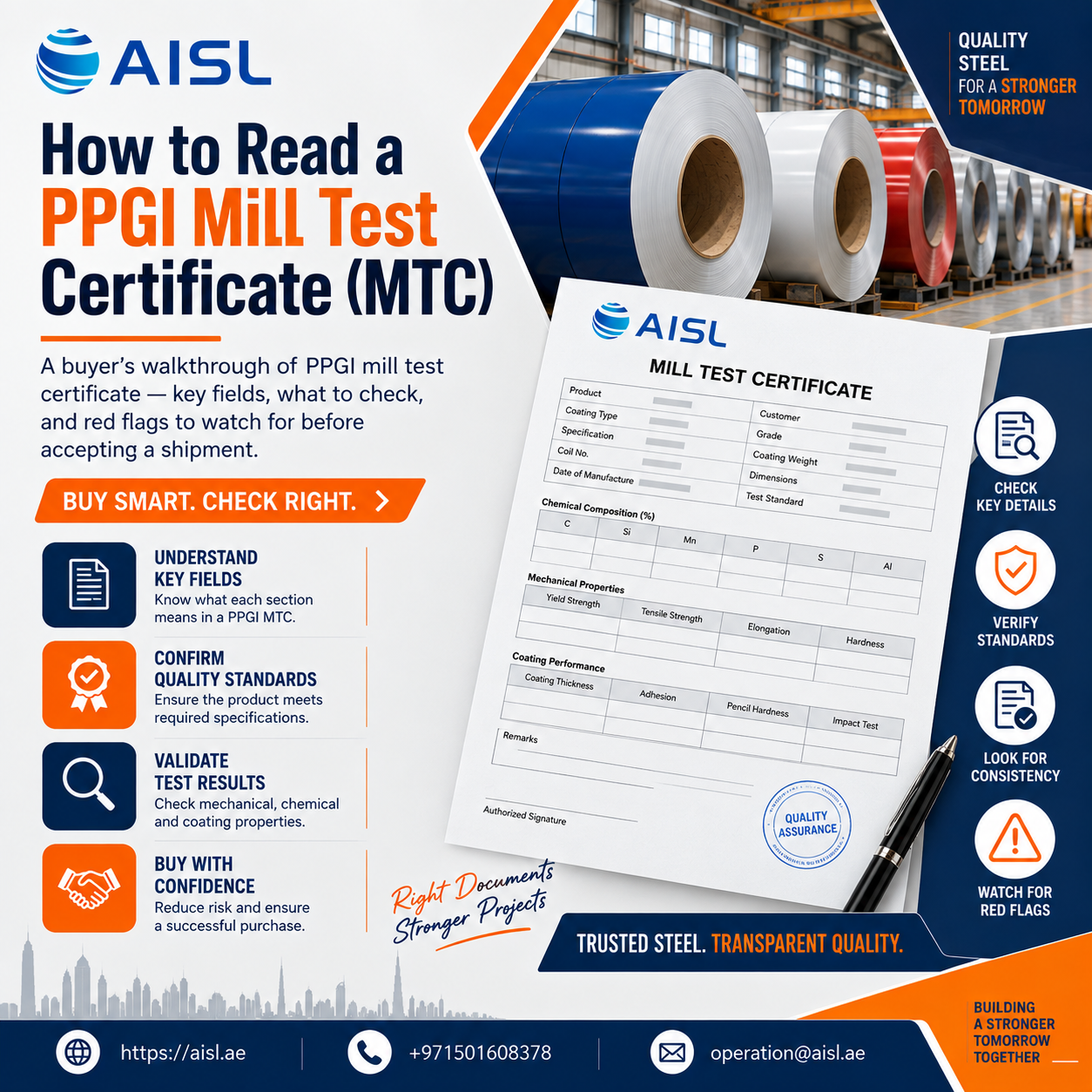
An MTC is a manufacturer-issued document confirming the tested chemical composition, mechanical properties, and coating specification of a specific production batch, traceable to a coil or lot number. It is not the same as a general product datasheet, which describes typical or nominal specifications for a product line rather than confirmed test results for the material actually in your shipment. If a supplier only provides a datasheet and not a batch-specific MTC, you have no verified confirmation of what you're actually receiving.
Key Fields to Check on a PPGI MTC
Coil or Batch Identification
Every MTC should reference a specific coil number, heat number, or batch number that matches the physical coil or shipment you received. If the certificate can't be matched to your actual delivery, it provides no real assurance — always cross-check the coil number on the certificate against the tag or marking on the physical coil.
Base Metal Grade
Look for the base steel grade (such as DX51D, DX52D, or S350GD) and confirm it matches your order specification. Different grades carry different mechanical properties — formability, tensile strength, yield strength — which matter for whether the material suits roll-forming, structural, or roofing applications as intended.
Chemical Composition
The MTC lists the tested chemical composition of the base steel, including carbon, manganese, phosphorus, and sulphur content. This confirms the steel meets the compositional requirements of its stated grade and standard (such as ASTM A653 or EN 10346).
Mechanical Properties
Tensile strength, yield strength, and elongation values confirm the steel performs as expected under load and during forming. These figures should fall within the range specified for the grade ordered — values significantly outside the expected range are worth querying with the supplier before acceptance.
Zinc Coating Weight
This is one of the most critical fields for PPGI buyers — the tested zinc coating weight, expressed as GSM or a Z rating (Z80, Z180, Z275), should match your ordered coating class. A coating weight below what was specified directly reduces corrosion resistance and service life, regardless of how good the paint finish looks.
Coating Thickness and Paint System
For prepainted coil, the MTC or accompanying documentation should confirm the primer and top coat thickness in microns, along with the paint system used (RMP, SMP, PVDF, or other). Confirm this matches your specified coating system, since paint chemistry directly affects UV resistance and expected service life.
Dimensional Tolerances
Thickness, width, and coil weight tolerances should be listed and fall within acceptable ranges for your order. Significant deviation from stated dimensions — particularly a lighter-than-expected coil weight for its stated size — is a common way buyers are shorted on international shipments.
Testing Standard Referenced
The MTC should cite the specific testing standard used (such as ASTM A653, EN 10346, or JIS G3302), which tells you what testing methodology and acceptance criteria were applied. This matters when comparing certificates from suppliers using different regional standards.
Red Flags to Watch For
A generic or templated-looking certificate with no batch-specific numbers, or values that appear identical across multiple different shipments, suggests the document may not reflect actual testing of your specific batch.
Missing coating weight or paint system fields on a certificate for prepainted coil — these should always be present and specific, not left blank or referenced only in general terms.
No third-party inspection option offered when requested — reputable suppliers should be willing to accommodate independent inspection (such as SGS) for buyers who want additional verification on larger orders.
Reluctance to provide the certificate before shipment or only offering it after payment is finalized, which limits your ability to query discrepancies before the material is already in transit.
Making the MTC Part of Your Standard Process
For any PPGI order, request the MTC before shipment, verify it matches your order specification field by field, and retain it for warranty and quality documentation purposes. For larger orders, consider requesting third-party inspection alongside the manufacturer's MTC for an additional layer of verification.
Certified, Traceable PPGI from AISL
Arabian Iron and Steel LLC (AISL) manufactures PPGI, GI, PPAZ, and PPAL coil at our Continuous Color Coating Line in Umm Al Quwain, UAE, under ISO 9001, ISO 14001, and ISO 45001 certification. Every batch we ship includes a full mill test certificate confirming coating weight, base metal grade, and paint specification, available on request before shipment.
If you'd like to review a sample MTC or discuss certification for an upcoming order, contact our team.